Do Brain Cancer Survivors Get Brain Cancer Again
Meningioma Recurrence
Featured Experts:

If you have been diagnosed with a meningioma and undergone brain tumor surgery to remove information technology, you're probably eager to get back to your life and put the experience behind you lot.
Chances are, your neurosurgeon has informed you lot that you volition need to return for regular screening. Why? Because even though the vast majority of meningiomas are treatable, they can render.
It's important to address a recurring meningioma promptly. Bug acquired by a tumor pushing on the brain or invading nerves or vessels are more difficult to reverse than they are to forestall.
What are meningiomas?
Meningiomas are tumors that ascend from the membranous layers that embrace the encephalon and spinal cord, not from the brain tissue itself. Tumors commonly grow over the years, instead of weeks or months, and tin exist removed surgically.
Biologically, virtually meningiomas are benign, but some tin exist very aggressive and hard to care for, especially when they surround nerves — such as the optic nervus, affecting vision — or blood vessels — such as the large sinuses that drain blood from the brain.
How probable is a meningioma to return?
In 1 study, virtually half of surgically removed meningiomas recurred after 20 years. That'south why in that location needs to be regular monitoring. Though meningioma patients are never completely "out of the woods," you can live a normal life while you're being vigilant with regular brain imaging.
Co-ordinate to experts at the Johns Hopkins' Comprehensive Brain Tumor Center, several factors can influence the hazard that a meningioma will come dorsum afterwards being treated with surgery lonely:
- Was the surgery able to remove all of the meningioma?
- What was the grade of the tumor?
- What were the size and location of the tumor? Was there more than one?
- How old is the patient? Is he or she more often than not healthy?
What happens if the surgeon can't completely remove a meningioma?
After meningioma surgery, your surgeon volition arrange for a postoperative scan inside a few days of your procedure. This scan helps ensure that the tumor and its fastened membrane (the dura) were completely removed. (A new meningioma can arise from the dura if information technology's non taken out.)
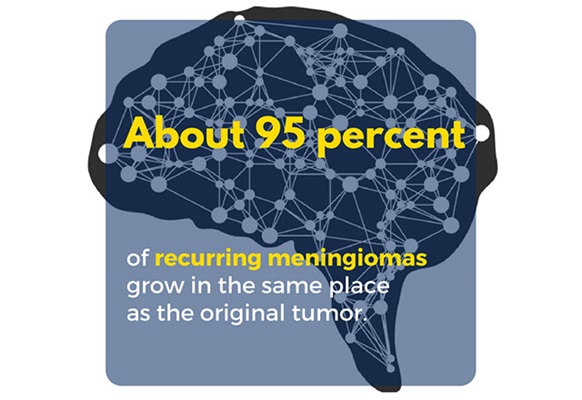
Complete removal of a meningioma and dura is the best way to avert a recurrence. However, there is still a 24 to 32 percentage hazard that a meningioma will recur in 15 years, even when the original tumor was completely removed. In about 95 percent of recurrences, the new meningioma grows in the same spot as before.
In some cases, total resection, or removal, is not possible. If a meningioma tumor is not removed completely, it is likely to regrow within 10 to 20 years.
What does a meningioma'southward grade have to do with its take a chance of recurring?
Up to 90 pct of meningiomas are grade 1. This means that the tumor's cells appear indolent (slowly growing) under a microscope and the tumor is not spreading.
Atypical or anaplastic meningiomas tend to involve the brain. They can recur and may also have necrosis (a core of dead cells inside the tumor), which is a malignant characteristic. These tumors are composed of chop-chop dividing cells, bookkeeping for their fast render.
Meningiomas that recur more than than twice are more than likely to be a college class. Some tin fifty-fifty be cancerous.
Tin radiation help forestall a meningioma recurrence?
Radiation therapy can exist used to reduce the size of a brain tumor in patients who are also ill for surgery and also destroy tumor remnants that were not able to be removed during surgery.
Radiation therapy for meningiomas can exist in the course of conventional radiation or intensity-modulated radiotherapy, a blazon of external beam radiation that uses reckoner-controlled radiations beams in conjunction with 3-dimensional CT images of the tumor site and surrounding area.
Stereotactic radiosurgery is another type of radiation that can be used on the remaining pieces of meningioma. Usually, patients only crave a unmarried treatment. Equally long equally the remaining tumor is not located too close to nerves or vessels, stereotactic radiosurgery is safe and causes fiddling harm to surrounding tissues.
For larger tumors or tumor remains that are close to critical nerves or claret vessels, your doc may choose fractionated radiation. This procedure involves administering several modest doses of radiation over a certain menstruum of time.
In rare instances when a recurrent meningioma becomes malignant, radiosurgery may be recommended. Typically, it takes some time for the tumor to answer to this treatment.
What should I look for in a treatment center for recurrent meningioma?
A combination of expertise is of import in deciding your treatment plan. The ideal squad has experts in neuro-oncology and neurosurgery who are working closely together. You need a group that will assist you follow up with regular exams to monitor your condition.
The squad at the Johns Hopkins Meningioma Center comprises viii neurosurgeons who acquit weekly conferences, back up one another in the operating room and interact on research that may lead to discovering new treatments.
Source: https://www.hopkinsmedicine.org/health/conditions-and-diseases/meningioma-recurrence
0 Response to "Do Brain Cancer Survivors Get Brain Cancer Again"
Post a Comment